Finding right balance
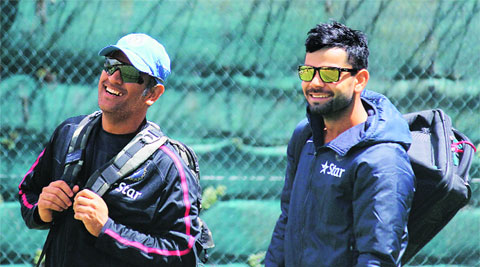 Dhoni doesn’t come across as a natural long-form leader and seems more comfortable captaining limited overs sides. (FILE)
Over the last three years, after every away series, India’s Test cricketers have been returning home dishevelled, their whites badly stained. The associated tumbles down the rankings ladder, would have disoriented them and left those following them disillusioned.
Here in England, India’s Test players are currently ambling along on their longest road-trip in white flannels in 18 years. The five-Test series unfolds this week following a couple of warm-ups against modest county teams. Once again, you fear for their whites.
Fanning these apprehensions are several inadequate Test CVs, depressing scoresheets compiled on foreign soil and the howling winds of change that the game has been grappling with for some time now.
To borrow a term, these young ‘long-format underachievers’ are Indian cricket’s ‘midnight’s children’. They got their India caps with the BCCI logo at a time when they sported a never-seen before golden glow. They had opened their eyes to a new world where money wasn’t merely trickling down the system; it cascaded like a torrent. This was a complex era of reforms where Tests were losing ground and playing less got you more.
Of this bunch of 18, 16 have made their Test debuts post the IPL. These T20 wealthies have made their millions while bowling four tight overs, hitting 24 runs off 6 balls or leading teams with proven match-winners from around the world. Those short evening-outings for two months annually not only got them easy money and stability but also contentment that made them averse to the Test grind.
Several drifted away but there have been others, like many in the present Test squad, who were not satisfied by the riches. They wanted to be respected for different reasons. Being a one-format specialist was an insult for them — it hurt their egos.
These cricketers wanted to be acknowledged as complete players by their peers. Virat Kohli’s obsession to succeed as a Test player can only be matched by Cheteshwar Pujara’s tireless efforts to be a T20 batsman. The pain on a crest-fallen Rohit Sharma’s face after the duck at Durban or Shikhar Dhawan’s long emotional namaskar to the skies, not his usual cocky mush-twirl, after his ton at Auckland have been heart-felt emotions shown by the IPL’s ‘marquee players’ in their whites. They have shown just how much success or failure in Tests meant to them.
WORLDS APART
What has not been often said is today’s cricketers face a far bigger challenge of adjusting to different formats as compared to the previous generation that mastered the relatively-easy toggle between Tests and that-90s-monster called ODIs. But T20 and Tests are a world apart. It’s like juggling with footballs one day and marbles the next.
A 20-day gap between the IPL final and the team’s departure to England means the Indians have, once again, hastily put on their whites. After seven seasons of this Test-IPL coexistence, the Indian batsmen, seem to have cracked the code, slowly but surely. During the last England tour in 2011, Rahul Dravid’s lead the batting charts with a stunning effort of 76 per game with Sachin Tendulkar a distant second with 34. In Australia next year, Kohli, averaging 37, was the best in a team that had gone from bad to worse.
It was in South Africa in 2013 that the tide turned. India had partnerships of a hundred and a double hundred in two Tests, the same returns from four Tests each in Australia and England. Pujara (averaging 70), Rahane (69) and Kohli (68) were the stars of the tour. Earlier this year in New Zealand there were three 100-run partnerships and three batsmen averaged over 50 once again. The openers continued to fail but the middle-order had settled.
So how is it that despite their ever-improving batting, India have not won abroad? Blame the bowlers and the captain. The pacers have failed to pitch the ball up, a prerequisite for success in Tests, while skipper Dhoni hasn’t come across as a natural long-form leader. He has let things drift and been extremely defensive at crucial times.
Too much T20
Too much of T20 has been the cause of both these aliments. Praveen Kumar, the most successful bowler on the last England tour, says bowlers can take a week or even up to a month to switch from T20 to Test length.
“There happens to be about a 1 meter difference between the two. It takes me about a week but it’s different for other bowlers,” he says.
Considering their T20 load, the present-day pace department just hope they get the rhythm to bowl 20-overs a day.
Bhuvneshwar Kumar topped the list for most dot-balls in a game for IPL-7. To be restrictive, he had to consistently pulled his length back as bowling full in the IPL meant a hit screaming towards the side screen.
Even a mis-hit would send the ball flying over the slip cordon. Having bowled 50-plus IPL overs, Bhuvneshwar’s de-IPLisation might take a while. The same is true of Mohammed Shami as well as Varun Aaron, who spent 2 months cutting down his pace, reducing his length and bowling yorkers pitched outside off-stump.
How you hopes the pacers had a reset command at hand to send them back to a factory-default configuration. Pankaj Singh is untested but the lack of an IPL contract provides hope.
On Ishant Sharma, judgment has been reserved. What can you say of a player who has figures of 6/51 and 0/164 in the last he played, in Wellington? You can only cross your fingers.
India’s problems while fielding multiply as these inconsistent bowlers are shepherded by a captain with a tendency to lapse into a brain freeze. Dhoni’s grooming as a leader did not happen in domestic games played on flat tracks under a fuming, hot sun. He learnt the art of captaincy wearing blue in the game’s shortest format.
Even while playing Tests, he loves saving runs and applauds loudest when Ravindra Jadeja darts through a maiden. Slips disappear early and the point fielder also makes a hasty retreat to the fence. Mid-wicket, long-on and long-off mushroom after most wicket-less hours. Placing a leg-slip is a favourite but over-used surprise. When even that doesn’t work, the team goes on auto-pilot. These will be the crucial periods of play where the series will be decided and there will be many on this long tour.
This is a young team that has three new fathers but most team rooms resemble bachelor pads. A reading habit is a rarity in a team that bonds over Playstation consoles. The talk in the dressing room mostly centers around the next flashy car, bike, phone or glares.
That’s why you fear for the whites. A few more stains and these group of boys, with a notoriously short attention-span, might just get bored. They might ditch the whites for good to embrace their beloved blue.
Yet the likes of Kohli, Pujara, Dhawan and Rahane have started defying these apprehensions, as the batting jigsaw looked like falling into place over the last few Tests abroad. Now if only Dhoni, the captain, could shrug off his defensive reticence and bowlers found their rhythm, the whites could dazzle rather than causing disillusionment.


