How much is gold worth?
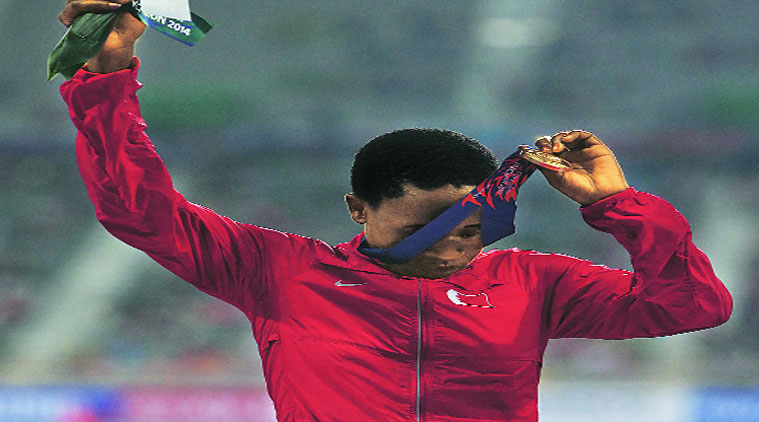 Bahrain’s Ruth Jebet won 3000m steeplechase gold, and a lot more. (Source: AP)
A man dressed in a maroon-and-white suit stepped out of a metallic grey sedan with a briefcase in hand and walked straight through the VIP entrance of the Asiad Main Stadium. It was nearing 10 pm on a damp Saturday night. The well dressed man entered without resistance into the athletes lounge, shook hands with a woman runner, handed her the briefcase and after not more than 10 minutes, was back in his car and on his way back.
It was a scene straight from a mafia movie. But the man wasn’t here to orchestrate a shady deal. Instead, he was representing the UAE Olympic Association and on behalf of the royal family, he made the short stop to deliver the cash prize to the Emirati nation’s golden girl Aliah Saeed Mohammad.
The 23-year-old had won the gold medal in the women’s 10,000m race and as per UAE government’s policy, was entitled to a hefty cash incentive. No one knows the amount of cash stacked in the bag. “It’s foolish to even speculate. They are rewarded with insane amounts,” a journalist friend from UAE says.
A lot at stake
There’s quite a lot at stake at the Asian Games than mere gold medals. For several countries eager to enhance their global sporting reputations, winning at the Games is a crucial chance to wave their flag. But many have also realised that the athletes need more incentive than just national honour to be motivated enough to compete with the best. The incentives are many and varied, but cash is the most common.
The Indian government will be rewarding the gold medal winners at Incheon with a cash prize of Rs20 lakh (approx $50,000), silver medal winners with Rs10 lakh ($25,000) and bronze winners with Rs6 lakh ($14,000). India have returned from Incheon with a total of 57 medals (11-9-37), eight less than the last edition. This is apart from the rewards they will receive from the state governments and their individual sponsors.
While the Indian athletes managed to get a good deal, Singapore is one of the most generous nations when it comes to rewarding the medal winners. The country’s five gold medallists stand to earn $200,000 each whereas the silver and bronze medallists will be richer by $100,000 and $50,000 respectively.
That’s for individual brilliance. For team events in which Singapore has succeeded, $320,000 will be awarded for gold, $160,000 for silver and & $80,000 for bronze medal winners. Hong Kong isn’t too far behind either, with a little more than $130,000 paid out to the gold medal winners in the last edition.
In China, no gold, no money
But continental and global sports powerhouse China isn’t that bountiful. The nation has been a constant dominant force, sitting comfortably at the top of the over all medals tally for decades. Even in this edition, China (337 medals as on Friday) lead second-placed South Korea by more than 100 medals, including 72 gold. Each of their 149 gold medal winners stand to be rewarded with 50,000 yuan, or approximately $10,000, each from the main and provincial governments.
However, the silver and bronze medal winners are not rewarded, which underlines the value put on winning gold in the country.
“We do not mean to undermine the achievements of the other medal winners, but our policy is very straightforward. For us, only one medal matters,” China’s shooting coach Wang Yifu said.
Intriguingly, hosts South Korea do things slightly differently here. Apart from paying a one-time bonus, the gold medal winning athletes also get a monthly stipend and the male athletes are exempted from compulsory national service. Gulf nations keep their rewards a secret, but it is believed that Bahrain awards its gold winners with approximately $400,000.
While majority of the nations provide some kind of incentives for their athletes, some country’s are not so generous. Reward-wise, Japan is the stingiest of them all. Bucking the trend, the state hasn’t offered any form of financial benefits in the last two editions of the Asian Games, despite their athletes helping the country finish in the top three on each occasion.
“We give bonuses for the Olympics because for many athletes that is the final big event of their career. But we don’t really believe in dangling carrots,” a Japan Olympic Committee official said. “Our policy is to focus on the long-term development of our athletes.”
But Japan have started a unique policy, in which their Olympic association doubles up as a placement agency for its retired athletes. They try to match the qualities of the athlete in the corporate world and set them up with giant multinationals.
The so-called happy country, Bhutan, also doesn’t pay much for a gold medal. The Buddhist country has sent its largest contingent for a multi-discipline event, sending 16 athletes. And their government announced a reward of $728, $520 and $416 for a gold, silver and bronze medal winner respectively.
However, the country did not manage to win a medal in Incheon.


