If the shoe fits: Who will give a 12-toed athlete a pair of trainers?
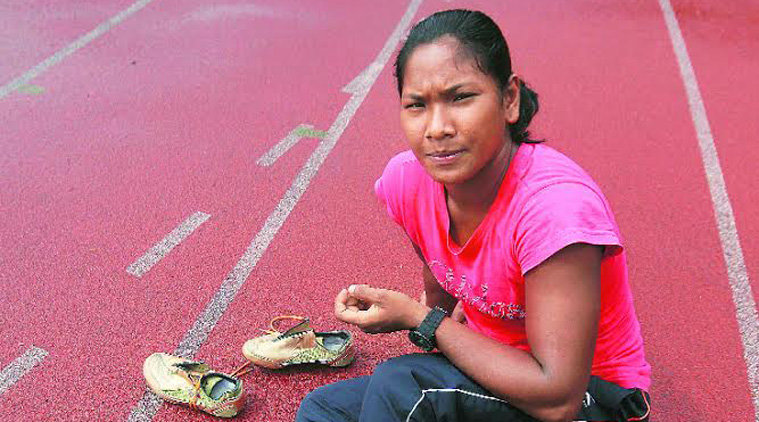 Born to a rickshaw puller father and a homemaker mother, Barman didn’t have the luxuries that could aid a budding athlete. (Express photo by Subham Dutta)
When you goad heptathlete Swapna Barman to talk about her first Asian Games experience in Incheon, South Korea, she flinches a little. That almost-cinematic moment when she was at the starting point of the running track of the swanky Asiad Main Stadium has been marred by pain for the 17-year-old. Imagine making the most important dash of your life in shoes a size too small. Imagine your toes curled into each other as you sprint towards a hurdle. “Every time I hit the surface, I feel a dull pain. But I am used to it now,” she says.
Barman was born with six toes in each foot but has not allowed her condition to stop her from going for gold. At the recently-concluded Asian Games, she travelled with five pairs of shoes but not a single pair was a perfect fit. Her performance at Incheon was “dismal”, she says — she came third in the women’s heptathlon 200m heats — because she “couldn’t even better her own record, leave alone winning a medal”. But Barman desists from placing the blame on her lack of quality footwear. “My mother has six toes in one foot, she never really cared about it. Back in my village in Jalpaiguri in north Bengal, people considered me lucky because of my condition. I never saw this as a deterrent in my career till I came to Kolkata two years ago,” she says.
Born to a rickshaw puller father and a homemaker mother, Barman didn’t have the luxuries that could aid a budding athlete. But she was the pampered one in the family, she got away with training in her local club for hours instead of helping out with household chores. Her talent was recognised quite early by her school coach, Biswajit Majumdar, and locality club coach, Sukanta Sinha, who groomed her to be a high jumper. In 2007, at the age of 11, Barman set a new state record in the high jump category. It was current coach, Subhas Sarkar, though, who suggested heptathlon to her, a track-and-field contest comprising seven events: 100 metres hurdle, high jump, shot put, 200 metres, long jump, javelin throw and an 800-metres run.
“She had the potential to be good in all the seven events. She has these bursts of energy that is very helpful in these events. I felt that it would be more exciting for her and I knew she was up for the challenge. I was proven right when she won a silver in the Asian Junior track-and-field event in Chinese Taipei this year,” says Sarkar. His confidence in Sarkar belies his initial scepticism about her. “I felt she was too short to be a good high-jumper. However, in time I realised that she is good with long jump and throw events, too. Last year, she began training for the heptathlon and this year she was good enough to qualify for the Asian Games,” says Sarkar.
Training in the big city, Barman was introduced to the concept of sports shoes. “Back home, I used to run and jump without shoes. In fact, I am more comfortable doing high jump without shoes,” she says. Training barefoot in the grass-covered fields of her village led to a lot of falls and cuts, but no serious damage. “When I started training on synthetic surface, I began wearing trainers. My feet felt imprisoned. Because of my extra toes, none of the shoes would fit me. My shoe size is five but when I wear shoes that size, it is too tight at the front. When I wear a larger size, it is too loose and lacks the grip I need to run,” says Barman.
So why does she need to wear shoes at all? “The rules and regulations of most international events don’t make it mandatory for athletes to wear shoes. But it’s very important to wear them to protect ones’ feet from synthetic surface. These surfaces are much harder than a grass or clay surface. If your feet are not cushioned, you may sustain serious injuries,” says Shanti Ranjan Dasgupta, a Kolkata-based sports medicine specialist.
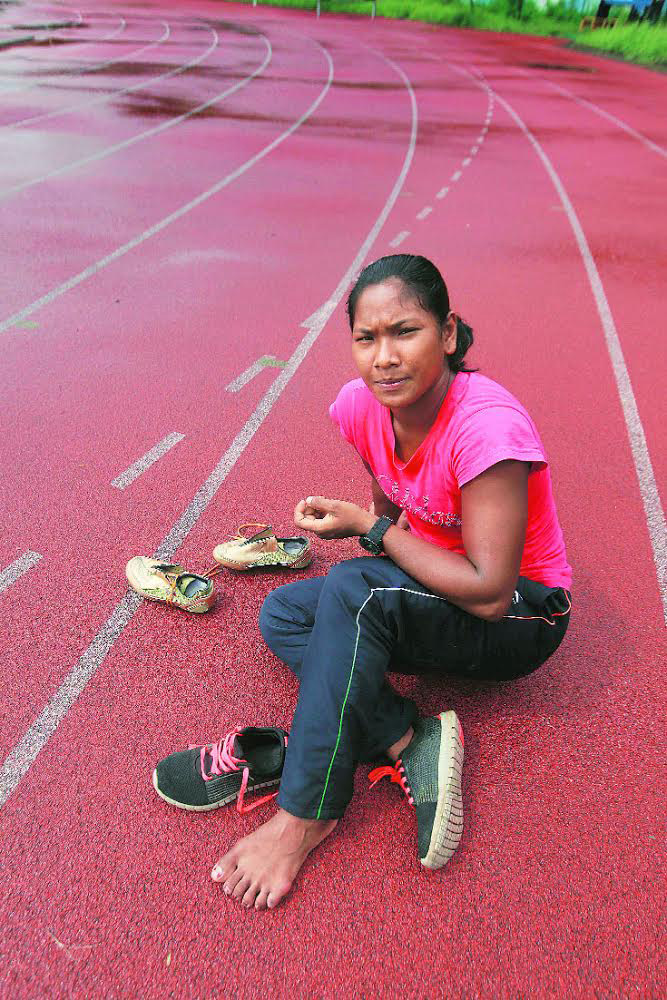
Barman is wearing a pair of black and orange Adidas trainers today. She peels off her skin-toned socks to reveal her left foot. It’s only after you start counting her toes that one realises that she has an extra digit. Sarkar points out the protruded bone just below her little toe. “This is the part that gets most affected. It ruptures frequently,” he says.
So far, Barman has not received any help from the state government. “If she gets proper shoes, she will definitely perform better. The shoes she has now pass muster for shot put and 800 metres but for other events she has to grin and bear the pain,” says Sarkar. Before Incheon, a number of local manufacturers volunteered to make shoes for her. Despite their best efforts, the product they delivered did not meet her needs.
Today, an online campaign started by para table tennis-athlete Suvarna Raj is petitioning Nike to provide custom-made shoes for Barman. The athlete and her coach are unaware of the nearly 29,000 signatures that have been collected so far. “Our past attempts to contact Nike and Adidas for custom-made shoes were met with stony silence,” says Sarkar. “It takes a lot of scientific research to make a pair of sport shoes. Companies like Nike have full-time engineers and scientists who have the knowhow to make a pair of shoes for Swapna, but why would they? She will not ensure business worth millions,” he says.


