A farewell note on a picture-postcard
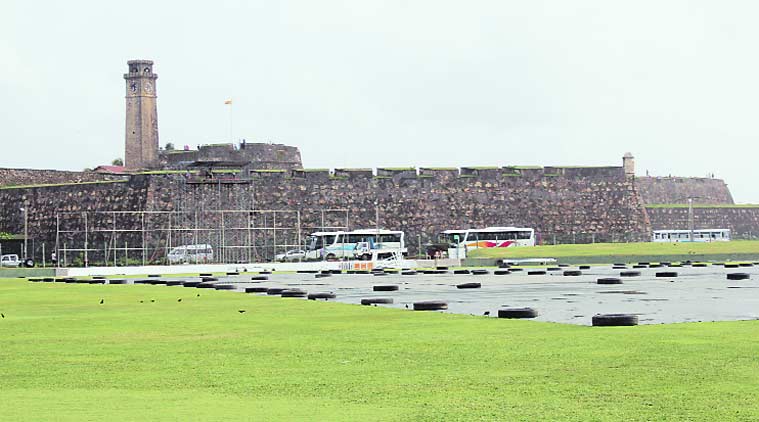 Tarpaulin sheets are on at the Galle ground as monsoon clouds loom overhead. The first Test is set to begin at this picturesque venue on Wednesday. (Express photo by Bharat Sundaresan)
IF they say sheep outnumber people in New Zealand, then it’s the coconut trees that have the upper hand over the human populace in Sri Lanka. Nowhere is this unstated fact more visible than when you travel southwards of the island. Maybe, the palmyrah might give them some stiff competition up north, but as you take the Dakshina Expressway from Colombo to Galle (Gall-la, like the Sinhalese pronounce it), the landscape on both sides of the three-lane highway is dominated by acres of coconut plantations, with their lanky, snaking stems rising to the sky.
It’s along this picturesque route that you realise for certain that the pastures are greener — literally so — on this side of the Palk Strait. Maybe it’s because of the much lower density of population in the Sri Lankan isle. While the new expressway, which was opened three years ago, does get you to Galle quicker. And the historic coastal city is one place in Sri Lanka you are always anxious to get to in a hurry — even if the beach and the surf aren’t your true calling in life. But what it has done is rob you of the truly mesmerising experience of riding along the coast, with the Indian Ocean glistening to your right, and the left dominated by signposts of the destruction it caused to such horrific extents a decade ago.
It does come into view, however, as you pay off the Rs 400 (around 250 INR) toll and enter the Galle city centre. You’re not allowed to soak in the vast expanse and the patronising impact the Indian Ocean has on you for too long as Galle’s another renowned feature — and one that’s dreaded by all cricket fans — makes its presence felt. Forecasts in Galle rarely indicate rain. It’s always thunderstorms, which are on the radar, and especially so at this time of the year. And you’re reminded of it upon arrival in Galle.



The forecasts over the next week — the first Test of the India-Sri Lanka series and the penultimate of Kumar Sangakkara’s career — aren’t the most positive. And the Galle International Cricket Stadium—or the Mahinda Rajapaksa Stadium as it’s been called of late — doesn’t fill you with much confidence either. The entire square, and a bit more — just outside the 30-yard-circle say where a mid-off fielder and long-off fielder would bump into each other if they went for the same high catch and didn’t head the other one coming — is covered in tarpaulin sheets, which are held down by unused tyres, like is the fashion across Sri Lanka. But the ground-staff are at work, double-shifts some, to ensure that the ground is in shape for the highly anticipated series opener. But ask them how much the rain would hamper the match, and they all throw quizzical looks before pointing at the sky and saying, “Here in Galle, you can never tell when it will rain, and how much.”
The ground itself is a testimony to the triumph of human spirit along with of course being one of the world’s most scenic venues — with the Galle fort looking over it like a doting parent. Chanaka, the watchman, who greets you with suspicion at first but then loosens up once you tell him your purpose of visit, was one of those present at the Stadium when it was literally swept away by the tsunami. He was also one of those who never gave up on the stadium regaining its lost glory.
“I’m paid only Rs 500 (Around 220 INR) a day but I still come here every day. I don’t want to work anywhere else,” he says. Just then, like is the case here, the heavens open up without any forewarning like a slingshot Lasith Malinga bouncer, and Chanaka is forced to cut-short the chat and run back to the comfort of his guard-house. Then he peeps his head out and assures you in his broken English, “Kumaarr last Test here no, rain no coming. What great player.”
An impending retirement
It’s almost like there’s always an impending retirement dominating the Test series when India tour here. Five years ago, it was at Galle that Muttiah Muralitharan orchestrated a fairytale ending to an epic career by getting Pragyan Ojha with his last ball in Test cricket to finish with 800 wickets. In three days’ time it will be Sangakkara who will be padding up for one final time at Galle, at a ground where he scored his first-ever ton, against who else but India back in 2001. In fact there’s either been a Sangakkara century, a Murali five-wicket haul or a swashbuckling Virender Sehwag century, each time the two teams have met at Galle—three occasions where India have won once and Sri Lanka twice. While Murali is now into his fifth year of retirement, Sehwag’s hopes of a Test comeback are fast fading, and that leaves Sangakkara to finish off his Galle l’affaire—an average of 53.6 in 22 Tests—in style.
As you turn right from the Galle stadium, you are taken through a narrow two-lane tunnel, and just like that you have entered Galle fort. Once inside, all you will encounter are a slew of slick cafes, bars, and a bounty of beach-enthusiastic Westerners. The coconut trees become a distant memory.
And in three days’ time you can expect the Sri Lankan faithful and Sangakkara fans, devotees even, to cover up all the green that dazzles around the Galle stadium as he plays for the final time in the twilight of his career under the eternal shade of the ‘fort that has witnessed his rise like no other’.


